The Program
The Institute for Disaster Management offers an undergraduate minor in disaster management that pairs well with any major, from public health and journalism to geography and international affairs. Through the minor program, students acquire a strong foundation in the knowledge and skills they need to apply disaster management to their specific area of focus or to continue on in the field of disaster management.
The structure and topical focus of the minor program engages students in both applied and scholarly work in emergency and disaster management. Coursework for the minor in disaster management focuses on the societal impacts and causes of natural and human-made hazards, including how these disasters can be mitigated, planned for, and adapted to.
Below, you will find information on the course work for the minor program and how to apply. More detailed information about each course is available here.
By the Numbers

Coursework
The minor consists of 15 semester hours of coursework, which must be completed with a grade of “C” or better.
The required anchor course for the minor is DMAN 3100, “Disasters and Society.” In this course, students explore the social contributors and impacts of disasters, and analyze key findings related to human behavior in disaster settings. Upon completion of the course, students will have a broad understanding of the core theories and frameworks that guide emergency preparedness, response, and research of disasters.
Following the foundations provided by DMAN 3100, students take an additional 12 semester hours of coursework. Here, at least three courses or 9 semester hours must be from the DMAN prefix, and no more than six hours of independent study credit may count toward the minor. Elective options for the minor include, but are not limited to, the following:
- DMAN 3200: Disaster Policy
- DMAN 3300: International Aspects of Disasters
- DMAN 3400: Disasters, Media, and Pop Culture
- DMAN 3750: How to Survive the Apocalypse
- DMAN 4100: Methods in Disaster Research
- DMAN 4960R: Faculty-Mentored Undergraduate Research I
- DMAN 4970R: Faculty-Mentored Undergraduate Research II
- ADPR 5120: Crisis Communication
- ANTH 3150: Water Worlds
- ATSC(GEOG) 3130: Atmospheric Hazards
- CVLE 3470L: Civil Engineering Laboratory – Structural
- GEOG 3640: The Geography of Human Rights
- GEOG 4/6370-4/6370L: Geographic Information Science
- HIST 3242: Disasters in the Caribbean and Latin America
- HPAM 3500: Introduction to Healthcare Management
- HPAM 3600: Introduction to Health Policy
- INTL 4440: Strategic Intelligence
- SOCI(INTL) 4700: Global Terrorism
- EHSC 4610: Water Pollution and Human Health
- EHSC 4200: Climate Change and Public Health
- EHSC 4090: Bioremediation
Sample Plans of Study
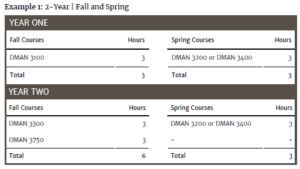
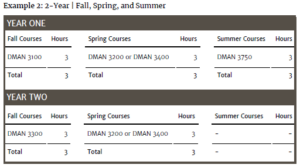
For the sample plans below, students may substitute one course or 3 credit hours for an elective outside of the Institute for Disaster Management. Students typically follow a 2-year plan of study. These are meant to serve as sample plans of study only.
How To Apply
There is no formal application process for the Disaster Management minor. Currently enrolled students who would like to add or remove a minor should log in to Athena. Under the Student tab, click the My Programs menu item. From there, you will be able to add/delete majors, emphasis areas, minors, and certificates. If you have any questions, please email ugaidm@uga.edu.
How to add a minor:
- Log in to Athena
- Under the Student tab, click the My Programs menu item
- In My Programs, complete the following steps:
- Click the Add Minor button
- Select “Disaster Management”
- Confirm your selection